
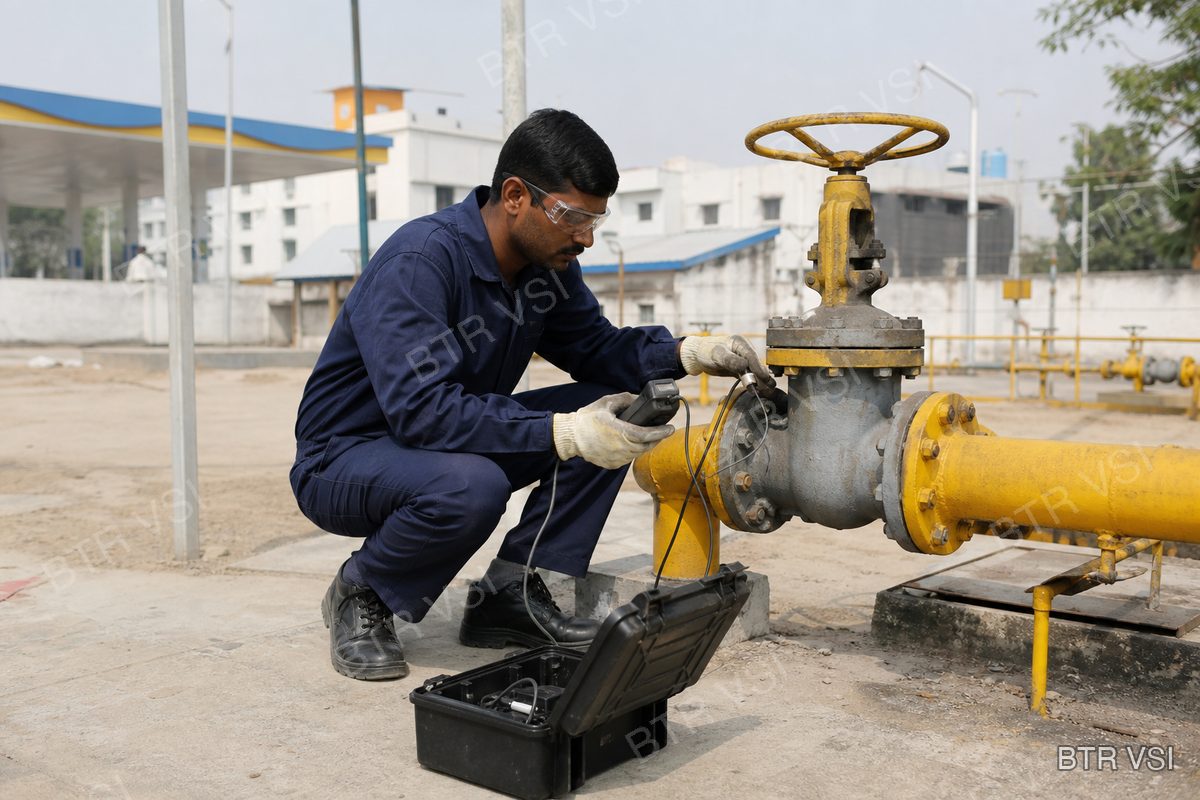
A city gas operator needed a passing valve attended within two days, paying only on success. Our technician completed the work in a single day on site. The operator paid under those terms and later commissioned a 30-valve preventive campaign.
Case study
A passing valve attended in one day on pay-on-success terms
The operator made payment due only after successful completion, and it paid.
The valve and its duty
A city gas operator found a passing valve on its distribution network. Passing means the closed valve still lets gas through the seat.
City gas distribution valves sit in stations and chambers along the network.
On a live gas network, a passing valve weakens isolation during maintenance and emergencies. Screening signs such as downstream pressure rise suggest passing, and a seat test confirms it.
The operator needed the valve attended on site within two days. Its commercial terms were direct: payment only after successful completion of the work.
Its email said to treat that message itself as the purchase order.
We accepted the terms and planned the visit around the operator's deadline. The operator carried no payment obligation until the work was complete and successful.
The intervention
Our technician travelled on the Sunday with high-pressure injection equipment. That equipment lets one technician treat a valve without cutting pipework or removing the valve.
Live treatment of this kind starts with checks, not injection.
- Confirm the valve carries injection fittings in good, serviceable condition.
- Check the valve design and gas service suit the planned treatment.
- Follow OEM guidance and the operator's own site permissions throughout.
- Inject controlled amounts within equipment ratings while watching the pressure response.
The valve work was completed in a single day on site. Our passing valve screening check explains how operators grade passing before treatment.
The payment and the follow-on
The operator then paid under the success-only terms it had set itself. Payment on those terms is the result we publish for this case.
A three-day preventive campaign followed at a second site for the same operator. Purge cleaner went into each of 30 valves during that campaign.
Nine valves also took measured lubricant sealant to lubricate seats and fill minor scratches. Operations would not allow the valves to be closed during the visit.
We documented the treatment honestly as partial and preventive work. The full online round was prescribed for a later window instead.
The operator later asked us to train its engineers, third-party inspectors and contractors. Pay-on-success terms shift the delivery risk to the service company, not the operator.
Terms like these depend on honest reporting. We report screening signs as indications and let a seat test confirm the repair.
See the field results from the full directory of 22 field cases. You can also review injection equipment that our technicians carry for one-day visits.
More field results
Related cases
A two-day trial that won a 30-valve follow-on order
The client set the test itself: prove the work in two days, then earn the fleet.
Read the case12 valves treated during a fertiliser plant turnaround
From one emergency call-out to a fixture in the shutdown calendar.
Read the case
Start with the valve condition
Tell us about the valves giving you trouble
Share the valve type, duty, location and the fault you found. An engineer replies within 24 hours.